Internet of Things (IoT): The Future of Connected Technology
Introduction
The Internet cof Things, ommonly known as IoT, is one of the most important technological developments of the modern digital era. It refers to the growing network of physical objects that are connected to the internet and capable of collecting, processing, exchanging, and sometimes acting on data. These objects can include smartphones, smart watches, home appliances, vehicles, industrial machines, agricultural equipment, medical devices, environmental sensors, and many other connected products.
In the past, the internet was primarily used to connect computers and people. Today, the internet increasingly connects physical objects. A smart thermostat can communicate with a mobile application. A fitness watch can collect information about activity and send it to a smartphone. A factory machine can report its operating condition to a monitoring system. A connected vehicle can exchange information with cloud services. These examples demonstrate how IoT connects the physical world with digital systems.
The importance of IoT comes from its ability to transform raw information from physical environments into useful digital intelligence. Sensors can observe conditions, communication networks can transmit information, cloud platforms can store and process data, and artificial intelligence can analyze patterns. Automated systems can then use those insights to make decisions or trigger actions.
IoT is affecting homes, businesses, healthcare, agriculture, transportation, manufacturing, energy, retail, cities, and environmental monitoring. It is also becoming increasingly connected with artificial intelligence, edge computing, cloud computing, robotics, cybersecurity, and 5G networks.
This article explores the Internet of Things in detail, including its definition, components, architecture, technologies, applications, advantages, challenges, security concerns, industry impact, and future possibilities.
What Is the Internet of Things?
The Internet of Things is a network of physical objects equipped with technologies that allow them to collect and exchange information.
An IoT device can contain:
- Sensors
- Software
- Processing capabilities
- Communication technologies
- Storage
- Power systems
- Actuators
The device collects information from its environment and may send that information to another system.
For example, a temperature sensor can measure environmental temperature. It can transmit the measurement to an IoT platform. The platform can analyze the information and display it on a dashboard.
An automated system could go one step further. If the temperature becomes too high, it could automatically activate cooling equipment.
This creates a basic IoT cycle:
Sense → Connect → Process → Analyze → Act
Why IoT Is Important
IoT is important because it allows organizations and individuals to understand physical environments in greater detail. Internet of Things (IoT)
Traditional systems often depend on humans manually collecting information.
IoT can automate this process.
For example, instead of an employee manually checking the temperature of a machine several times each day, sensors can monitor it continuously. Internet of Things (IoT)
This can provide:
- Real-time information
- Faster responses
- Better decision-making
- Automation
- Improved efficiency
- Predictive maintenance
- Resource optimization
IoT therefore transforms physical activities into measurable digital information.
History of IoT
The idea of connecting physical objects to networks is not entirely new. Internet of Things (IoT)
Early forms of machine-to-machine communication existed before the modern IoT ecosystem.
As internet connectivity became more widespread, organizations began connecting sensors, industrial machines, appliances, and other devices.
The development of inexpensive sensors, wireless networks, cloud computing, smartphones, and powerful processors accelerated IoT adoption.
The term “Internet of Things” became increasingly popular as connected devices expanded beyond traditional computers.
Today, IoT includes billions of connected devices across consumer, industrial, commercial, and public environments.
Components of an IoT System
A typical IoT system contains several major components. Internet of Things (IoT)
1. Devices
Physical devices collect information or perform actions.
2. Sensors
Sensors measure environmental conditions Internet of Things (IoT).
3. Connectivity
Networks allow devices to communicate.
4. Edge Processing
Some data can be processed close to the device.
5. Cloud Platforms
Cloud systems provide storage and large-scale processing.
6. Analytics
Software analyzes collected data.
7. Applications
Users interact with IoT systems through applications and dashboards. Internet of Things (IoT)
8. Actuators
Actuators allow systems to perform physical actions.
These components work together to create an intelligent connected system.
IoT Sensors
Sensors are one of the most important components of IoT.
A sensor converts a physical condition into measurable information.
Examples include: Internet of Things (IoT)
- Temperature sensors
- Humidity sensors
- Pressure sensors
- Motion sensors
- Light sensors
- Sound sensors
- Proximity sensors
- Gas sensors
- Accelerometers
- GPS sensors
A connected device may contain several sensors at the same time.
For example, a smart watch can use motion sensors, heart-rate-related sensors, location technology, and other components to collect information.
IoT Actuators
Sensors collect information, while actuators can perform actions.
An actuator converts a digital command into a physical action.vInternet of Things (IoT)
Examples include:
- Motors
- Valves
- Relays
- Heating systems
- Locks
- Switches
For example, a smart irrigation system can use soil sensors to detect conditions and then activate a water valve when appropriate.
This creates a closed-loop IoT system.
Connectivity in IoT
IoT devices need communication technologies to exchange information. Internet of Things (IoT)
Different applications require different types of connectivity. Internet of Things (IoT)
Common options include:
- Wi-Fi
- Bluetooth
- Cellular networks
- Zigbee
- Thread
- LoRaWAN
- Ethernet
- Satellite communication
- Near-field communication
The appropriate technology depends on factors such as range, bandwidth, power consumption, cost, and environment. Internet of Things (IoT)
Wi-Fi and IoT
Wi-Fi is widely used for IoT devices in homes, offices, and other locations with existing wireless networks.
It provides relatively high bandwidth and is convenient for devices that have access to continuous power. Internet of Things (IoT)
Smart televisions, cameras, appliances, and home automation systems commonly use Wi-Fi.
However, Wi-Fi can consume more energy than some low-power IoT communication technologies.
Bluetooth and IoT Internet of Things (IoT)
Bluetooth is useful for short-range communication.
Bluetooth Low Energy, commonly called BLE, is designed for devices that need to conserve power.
Wearable devices, health sensors, accessories, and smart home products can use BLE to communicate with smartphones or gateways.
Cellular IoT
Cellular networks can provide wide-area connectivity. Internet of Things (IoT)
IoT devices can use cellular technologies to communicate without relying on local Wi-Fi.
This is useful for:
- Vehicles
- Fleet tracking
- Remote monitoring
- Smart infrastructure
- Industrial equipment
- Internet of Things (IoT)
Newer cellular technologies can support large numbers of connected devices.
5G and IoT
5G networks are expected to support many IoT applications.
Important characteristics include:
- High bandwidth
- Low latency in appropriate configurations
- Support for large numbers of connected devices
- Improved network capabilities
Industrial automation, connected vehicles, smart cities, and other advanced applications may benefit from 5G connectivity.
However, IoT does not require 5G for every application. Many devices work effectively with other network technologies. Internet of Things (IoT)
Low-Power IoT Networks
Many IoT devices operate on batteries and need to function for long periods.
Low-power wide-area networking technologies are designed for applications that send relatively small amounts of information over long distances while conserving energy.
These networks can be useful for:
- Agricultural sensors
- Environmental monitoring
- Utility meters
- Smart infrastructure
- Remote equipment
IoT Gateways Internet of Things (IoT)
An IoT gateway connects devices to larger networks or cloud systems.
A gateway can perform several functions. Internet of Things (IoT)
It may:
- Collect data
- Translate protocols
- Filter information
- Perform local processing
- Provide security
- Connect devices to the internet Internet of Things (IoT)
Gateways can be particularly useful when sensors use local communication technologies that cannot directly connect to cloud services.
Edge Computing and IoT Internet of Things (IoT)
Edge computing processes information closer to where it is generated.
Instead of sending all IoT data to a distant cloud server, an edge device can analyze some information locally.
For example, a factory camera could detect an unusual event locally instead of transmitting every Internet of Things (IoT)video frame to the cloud.
Benefits can include:
- Lower latency
- Reduced bandwidth
- Faster responses
- Improved privacy
- Greater resilience when connectivity is limited
Edge computing and IoT are therefore closely connected.
Cloud Computing and IoT Internet of Things (IoT)
Cloud computing provides scalable infrastructure for IoT systems.
Cloud platforms can store enormous amounts of sensor data. Internet of Things (IoT)
They can also provide:
- Databases
- Analytics
- Machine learning
- Device management
- Dashboards
- APIs
- Automation
A common IoT architecture combines devices at the edge with cloud systems for large-scale processing. Internet of Things (IoT)
IoT Data Internet of Things (IoT)
IoT devices can generate enormous amounts of data.
A single sensor may generate thousands or millions of measurements over time.
Organizations therefore need effective systems for:
- Data collection
- Storage
- Processing
- Analysis
- Visualization
- Security
- Retention
Raw data is not automatically useful. Internet of Things (IoT)
The real value comes from turning data into actionable information.
IoT Analytics Internet of Things (IoT)
Analytics helps organizations understand information collected from connected devices.
Analytics can answer questions such as:
- What is happening?
- Why is it happening?
- What might happen next?
- What action should be taken? Internet of Things (IoT)
For example, an industrial company can analyze machine vibration data to identify patterns associated with potential equipment problems.
Artificial Intelligence and IoT Internet of Things (IoT)
AI can make IoT systems more intelligent.
Traditional IoT systems may simply collect and display data.
AI-enabled IoT systems can identify patterns, predict events, and automate decisions. Internet of Things (IoT)
Examples include:
- Predictive maintenance
- Intelligent traffic management
- Smart energy optimization
- Automated quality inspection
- Crop monitoring
- Anomaly detection
The combination of AI and IoT is sometimes described as intelligent IoT.
Machine Learning in IoT Internet of Things (IoT)
Machine learning can analyze historical IoT data and identify patterns. Internet of Things (IoT)
For example, a machine-learning model could learn what normal equipment behavior looks like.
When sensor readings become unusual, the system could generate an alert.
Machine learning can also support forecasting.
An energy management system could use historical consumption patterns to predict future demand.
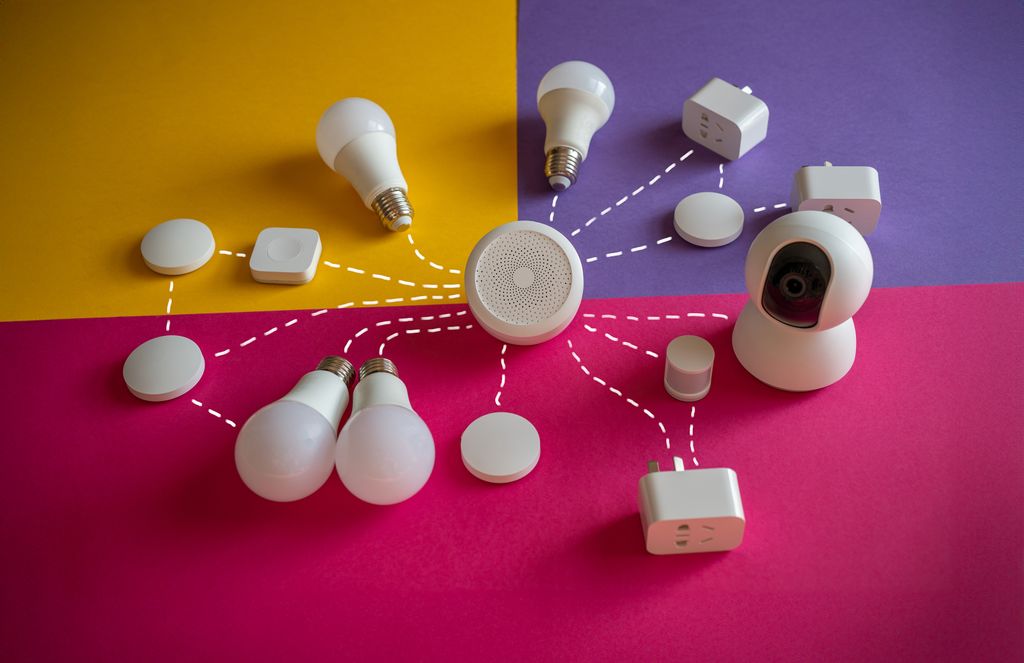
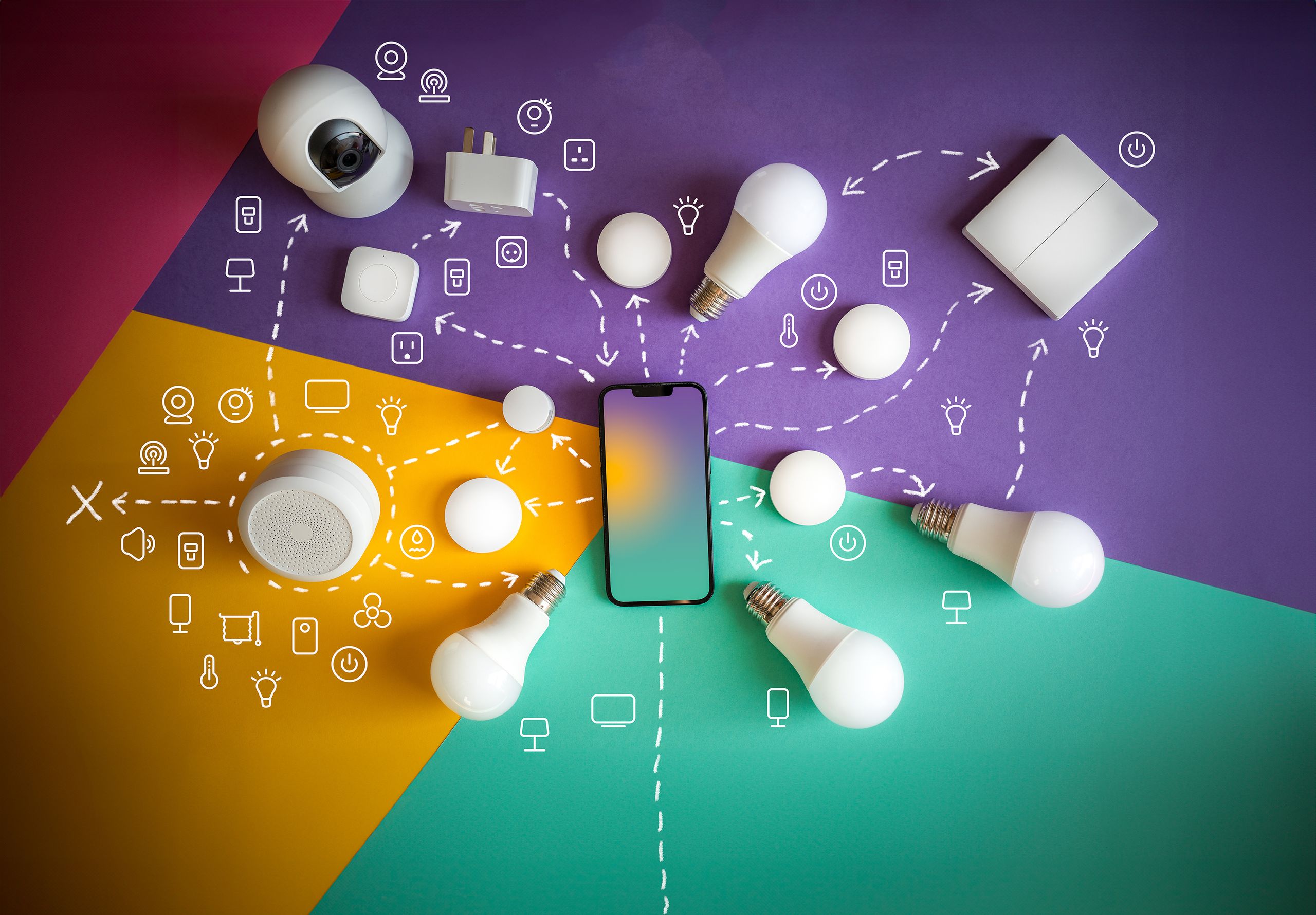
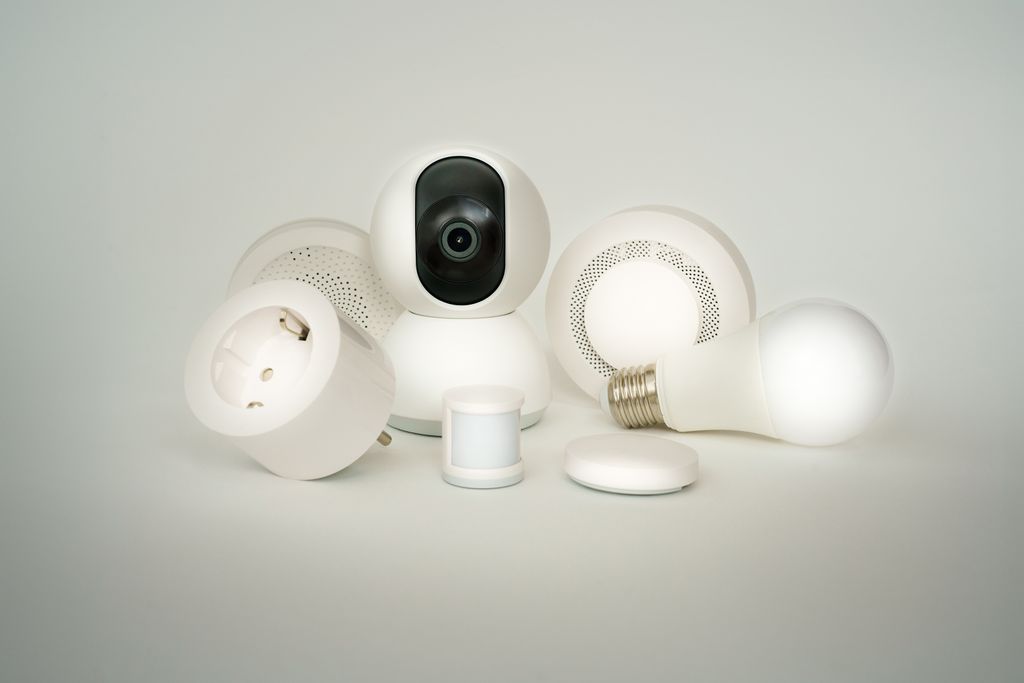
IoT in Smart Homes
Smart homes are among the most visible applications of IoT.
Connected home devices can include: Internet of Things (IoT)
- Smart lights
- Thermostats
- Security cameras
- Door locks
- Sensors
- Appliances
- Smart speakers
- Energy monitors
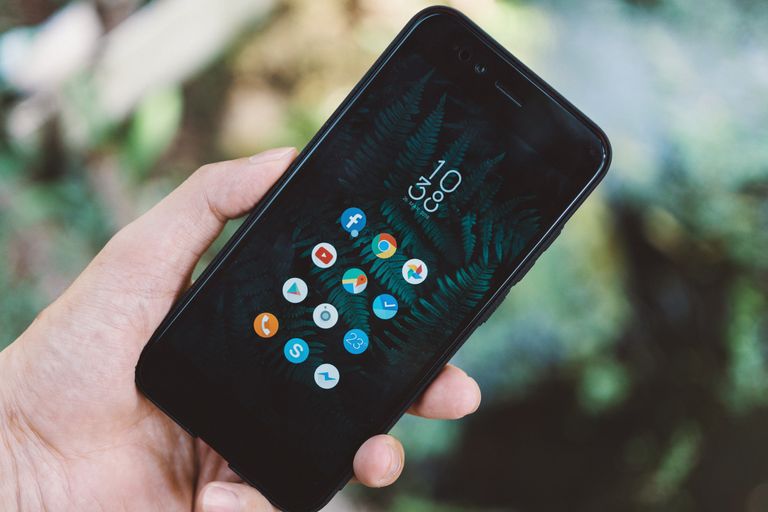
Users can control many devices through mobile applications or other interfaces.
Automation can connect multiple devices together.
For example, a home system could turn lights on when movement is detected and adjust environmental settings according to predefined rules.
Smart Lighting Internet of Things (IoT)
Smart lighting systems use connected bulbs, switches, and sensors.
Users can control lighting remotely or automate it based on:
- Time
- Motion
- Occupancy
- Environmental conditions
Smart lighting can also support energy management by reducing unnecessary usage.
Smart Energy Management
IoT can help households understand energy consumption.
Connected meters and appliances can provide detailed information about electricity use.
Users can identify high-consumption devices and adjust behavior.
Automated systems can also optimize energy consumption based on demand or predefined rules.
IoT in Healthcare
Healthcare is an important area for IoT.
Connected medical and wearable devices can collect information that supports monitoring and healthcare services.
Examples include:
- Wearable activity devices
- Remote monitoring equipment
- Connected medical equipment
- Environmental sensors
- Medication-related systems
IoT can help healthcare organizations collect information more efficiently.
However, healthcare IoT involves highly sensitive information and therefore requires strong privacy and security protections.
Wearable Technology
Wearables are IoT devices designed to be worn on the body.
Examples include:
- Smart watches
- Fitness trackers
- Connected sports devices
- Specialized monitoring devices
They can collect information about movement, activity, location, and other measurable signals.
Wearables demonstrate how IoT can become part of everyday life.
IoT in Manufacturing
Manufacturing is one of the most important industrial IoT applications.
Industrial IoT, often called IIoT, connects machines, sensors, production systems, and software platforms.Internet of Things (IoT)
Factories can monitor:
- Machine performance
- Production rates
- Temperature
- Vibration
- Energy consumption
- Product quality
This information can improve operational visibility.
Predictive Maintenance
Predictive maintenance is one of the major benefits of industrial IoT.
Traditional maintenance may follow a fixed schedule.
For example, a machine might be inspected every month regardless of its condition.
IoT enables condition-based monitoring. Internet of Things (IoT)
Sensors can track machine behavior continuously.
Analytics can identify changes that may indicate developing problems.
Maintenance teams can then investigate equipment before a major failure occurs.
Smart Factories
A smart factory combines connected machines, sensors, automation, analytics, and digital systems.
Machines can communicate with production platforms.
Robots can coordinate with other equipment.
Data can be analyzed in real time.
Managers can monitor production through digital dashboards.
This approach is often associated with Industry 4.0.
IoT in Agriculture Internet of Things (IoT)
Agriculture can benefit from connected sensors and intelligent systems.
IoT devices can monitor:
- Soil moisture
- Temperature
- Humidity
- Weather
- Crop conditions
- Water usage
Farmers can use this information to make better decisions.
Precision Agriculture
Precision agriculture uses technology to manage farms more efficiently.
IoT sensors can identify differences in soil and environmental conditions.
Farmers can use the information to determine where water, fertilizer, or other resources may be needed.
This can reduce unnecessary resource usage. Internet of Things (IoT)
Smart Irrigation Internet of Things (IoT)
Smart irrigation systems use sensors to determine environmental conditions.
If soil moisture is sufficient, irrigation can potentially be reduced.
If conditions become dry, the system can activate watering equipment.
This can help manage water more efficiently.
IoT in Transportation Internet of Things (IoT)
Transportation systems increasingly use connected technologies.
IoT applications include:
- Vehicle tracking
- Fleet management
- Traffic monitoring
- Smart parking
- Road monitoring
- Public transportation systems Public transportation systems
Connected vehicles can generate information about location, performance, and operating conditions.
Fleet Management
Companies operating fleets can use IoT devices to monitor vehicles.
Information can include:
- Location
- Fuel consumption
- Vehicle condition
- Driving patterns
- Route information
Managers can use this information to improve logistics and maintenance planning.
Connected Vehicles Internet of Things (IoT)
Connected vehicles can communicate with cloud services and other systems.
They may provide information about:
- Vehicle status
- Navigation
- Traffic
- Maintenance
- Location
Connected vehicle technology is an important part of the development of intelligent transportation systems.
IoT in Smart Cities
Smart cities use connected technologies to improve urban services.
IoT sensors can monitor:
- Traffic
- Parking
- Air quality
- Street lighting
- Waste management
- Water systems
- Public infrastructure
Cities can use this information to improve efficiency and services.
Smart Traffic Management Internet of Things (IoT)
Traffic sensors can provide information about vehicle movement.
Cities can analyze this data to understand congestion and improve traffic management.
Connected traffic lights can potentially adapt to changing conditions.
This can help improve transportation efficiency.
Smart Parking
Connected parking systems can identify available parking spaces.
Drivers can use mobile applications to find available locations.
This can reduce the time spent searching for parking. Internet of Things (IoT)
It may also reduce unnecessary vehicle movement in crowded areas.
Smart Waste Management
IoT sensors can monitor waste containers.
When a container reaches a certain level, a collection request can be generated.
This can help waste management organizations optimize collection routes.
IoT in Retail Internet of Things (IoT)
Retailers use IoT for inventory management, customer experiences, and store operations.
Connected sensors can monitor product movement and environmental conditions.
Retailers can use IoT to improve:
- Inventory visibility
- Supply chains
- Store management
- Customer experiences
Smart Shelves Internet of Things (IoT)
Smart shelves can use sensors to monitor inventory.
They can identify when products are removed or when stock levels become low.
This information can help employees replenish products more efficiently.
IoT in Logistics Internet of Things (IoT)
IoT helps companies track goods as they move through supply chains. Internet of Things (IoT)
Sensors can monitor:
- Location
- Temperature
- Humidity
- Movement
- Package conditions
This is particularly useful for goods that require controlled environments.
Cold Chain Monitoring Internet of Things (IoT)
Some products must remain within specific temperature conditions during transportation and storage.
IoT sensors can continuously monitor temperature.
If conditions become abnormal, the system can send an alert.
This can help protect sensitive products.
IoT in Energy
Energy companies use connected sensors to monitor infrastructure. Internet of Things (IoT)
IoT applications can include:
- Smart meters
- Grid monitoring
- Equipment monitoring
- Renewable energy systems
- Energy demand analysis
Connected infrastructure can provide more detailed information about Internet of Things (IoT)energy production and consumption.
Smart Grids Internet of Things (IoT)
A smart grid uses digital technologies and sensors to improve electricity distribution.
It can provide information about:
- Energy demand
- Network conditions
- Equipment performance
- Power consumption
Smart-grid technologies can support more flexible energy management.
Renewable Energy and IoT
IoT can support renewable energy systems.
Solar and wind installations can use sensors to monitor:
- Energy production
- Equipment condition
- Environmental conditions
Analytics can help operators understand system performance and identify maintenance requirements.
IoT in Environmental Monitoring
IoT can be used to monitor environmental conditions.
Sensors can measure:
- Air quality
- Water quality
- Temperature
- Humidity
- Noise
- Weather conditions
Environmental monitoring systems can provide real-time information for researchers and authorities.
IoT and Disaster Management
Connected sensors can support early detection and monitoring of environmental events.
For example, sensor networks can monitor:
- Water levels
- Weather conditions
- Soil movement
- Structural conditions
IoT does not eliminate disasters, but timely information can help organizations respond more effectively.
IoT in Buildings
Smart buildings use connected sensors and systems to manage building operations.
IoT can monitor:
- Occupancy
- Lighting
- Temperature
- Energy usage
- Security
- Equipment
Building management systems can automatically adjust resources according to conditions.
Occupancy Monitoring
Sensors can detect whether rooms or areas are being used.
This information can help organizations manage:
- Lighting
- Heating
- Cooling
- Cleaning
- Workspace allocation
Occupancy data can support more efficient building management.
IoT and Security
Security systems increasingly use connected cameras, sensors, alarms, and access-control systems.
IoT can provide real-time information about physical environments.
However, connected security devices also introduce cybersecurity risks.
A compromised device could become an entry point into a larger network.
Security must therefore be integrated into IoT deployments.
IoT Cybersecurity
IoT security is a major challenge because IoT ecosystems can contain large numbers of devices.
Some devices have limited computing resources and may be difficult to update.
Security concerns include:
- Weak passwords
- Outdated software
- Unencrypted communication
- Poor access control
- Insecure firmware
- Inadequate device management
Manufacturers and users need to address these issues.
Secure Authentication
IoT devices should use strong authentication mechanisms appropriate for their capabilities.
Default credentials should be changed or securely managed.
Devices should only receive the permissions they require.
Encryption
Sensitive IoT communications should use appropriate encryption.
Encryption can help protect information while it travels between devices, gateways, and cloud systems.
Firmware Updates
IoT devices may contain software vulnerabilities discovered after deployment.
Secure update mechanisms allow manufacturers to distribute fixes.
Devices that cannot be updated easily can become long-term security risks.
Device Management
Large IoT deployments require centralized device management.
Organizations may need to know:
- Which devices are connected
- Which software versions they use
- Where they are located
- Whether they are online
- Whether they have security problems
Device management platforms can help maintain large fleets of connected devices.
IoT Privacy
IoT devices can collect detailed information about people and environments.
Examples include:
- Location information
- Activity patterns
- Home behavior
- Device usage
- Environmental information
Organizations need responsible policies for collecting, storing, and using such information.
Users should have appropriate transparency and control.
Data Ownership
IoT systems can create questions about who owns the generated data.
For example, information collected by a connected industrial machine may be valuable to the manufacturer, equipment owner, service provider, and software platform.
Contracts and policies should clearly define data access and responsibilities.
IoT Standards and Interoperability
IoT ecosystems often contain devices from different manufacturers.
Interoperability allows these devices and platforms to communicate effectively.
Without common standards, organizations may become dependent on specific vendors.
Standards can help create more open and flexible IoT environments.
IoT Platforms
IoT platforms provide tools for managing connected devices and data.
A platform may provide:
- Device registration
- Device management
- Data ingestion
- Storage
- Analytics
- Dashboards
- APIs
- Security
These platforms can simplify development by providing common infrastructure.
IoT APIs
APIs allow IoT platforms to communicate with applications and other systems.
A mobile application may use an API to request sensor information.
An enterprise system may use APIs to integrate IoT data into business processes.
APIs are therefore an important part of IoT architecture.
IoT Protocols
Different IoT environments use different communication protocols.
Examples include:
- MQTT
- CoAP
- HTTP
- AMQP
- Bluetooth
- Zigbee
- Thread
- LoRaWAN
The appropriate protocol depends on application requirements.
MQTT
MQTT is a lightweight messaging protocol widely used in IoT.
It uses a publish-subscribe model.
Devices can publish messages to topics, while other systems subscribe to those topics.
MQTT is useful for environments where bandwidth and device resources are limited.
IoT Architecture
A simplified IoT architecture can be divided into several layers.
Device Layer
Contains sensors and actuators.
Network Layer
Provides connectivity.
Edge Layer
Performs local processing.
Platform Layer
Provides data storage and management.
Application Layer
Provides user-facing functionality.
Analytics Layer
Transforms data into useful information.
These layers may be implemented differently depending on the system.
IoT Data Processing
IoT data can be processed in different ways.
Real-Time Processing
Information is analyzed immediately.
Useful for:
- Industrial alerts
- Security systems
- Traffic management
Batch Processing
Data is collected and analyzed later.
Useful for:
- Long-term reports
- Historical analysis
- Trend detection
Many systems use both approaches.
IoT and Digital Transformation
IoT is a major component of digital transformation.
Organizations can use connected devices to digitize physical processes.
For example, a manufacturing company can connect machines to digital platforms.
This creates visibility that was previously unavailable.
IoT can therefore help businesses move from manual processes toward data-driven operations.
IoT and Business Intelligence
IoT data can be combined with other business information.
For example, a company can combine:
- Machine data
- Sales information
- Inventory
- Customer demand
- Supply-chain information
This can provide a broader view of business operations.
IoT and Predictive Analytics
Predictive analytics can use IoT data to forecast future events.
For example:
- Predict equipment failures
- Forecast energy demand
- Predict traffic conditions
- Estimate inventory requirements
This can help organizations move from reactive to proactive operations.
IoT and Automation
Automation allows IoT systems to respond to data without human intervention.
For example:
Sensor detects condition → software analyzes it → automated decision → actuator responds.
This can create highly efficient systems.
Benefits of IoT
IoT provides many potential benefits.
Improved Efficiency
Connected systems can automate monitoring and operations.
Better Decision-Making
Real-time data can support informed decisions.
Reduced Costs
Automation and predictive maintenance can reduce certain operational expenses.
Improved Customer Experience
Connected services can provide greater convenience.
Predictive Maintenance
Organizations can identify potential equipment problems earlier.
Resource Optimization
IoT can help manage energy, water, inventory, and other resources.
Challenges of IoT
IoT also creates significant challenges.
Security
More connected devices create more potential attack points.
Privacy
Devices can collect detailed information.
Complexity
Large deployments can involve thousands or millions of devices.
Interoperability
Different devices may use different standards.
Data Management
Huge amounts of data require scalable infrastructure.
Connectivity
Remote devices may have unreliable network access.
Power Consumption
Battery-powered devices must operate efficiently.
Cost
Large deployments can require substantial investment.
IoT Scalability
A small IoT project may involve only a few sensors.
Large deployments can involve millions of devices.
Scalable IoT architectures need to handle:
- Device registration
- Authentication
- Data ingestion
- Storage
- Processing
- Monitoring
- Software updates
Cloud and edge computing can help support large deployments.
IoT Reliability
IoT systems may operate in environments where network connectivity is unreliable.
Devices should be able to handle temporary disconnections when appropriate.
Edge processing can reduce dependence on constant cloud connectivity.
Redundant systems can improve reliability for critical applications.
IoT Power Management
Many IoT devices operate on batteries.
Power-efficient design is therefore important.
Devices can conserve energy by:
- Sleeping when inactive
- Sending data less frequently
- Using low-power communication
- Processing information efficiently
Energy harvesting technologies may also support certain specialized applications.
IoT and Blockchain
Blockchain has sometimes been proposed as a technology for IoT security and data sharing.
It can potentially provide distributed records of transactions and device interactions.
However, blockchain is not necessary for every IoT system.
IoT architectures should use blockchain only when its characteristics provide meaningful value.
IoT and Digital Twins
A digital twin is a digital representation of a physical object or system.
IoT sensors can continuously provide information to a digital twin.
For example, a factory machine can have a digital model that reflects its current operating conditions.
Organizations can use digital twins for:
- Monitoring
- Simulation
- Maintenance
- Optimization
- Planning
Digital twins are becoming increasingly important in industrial applications.
IoT and Robotics
Robots can use IoT technologies to communicate with sensors, cloud systems, and other machines.
A warehouse robot can receive information about inventory and tasks.
A factory robot can communicate with production systems.
IoT can therefore help create connected robotic environments.
IoT and Autonomous Systems
Autonomous systems need information about their environment.
IoT networks can provide additional data to autonomous machines.
For example, connected infrastructure can provide information about traffic, weather, or road conditions.
Combining IoT with AI can make autonomous systems more capable.
IoT in Supply Chain Management
IoT provides visibility into supply chains.
Connected devices can track goods from production through transportation and delivery.
Companies can identify delays and environmental problems more quickly.
This can improve supply-chain transparency.
IoT in Construction
Construction companies can use IoT sensors to monitor equipment, workers, materials, and environmental conditions.
Connected equipment can provide information about usage and maintenance.
Sensors can also help monitor building structures during and after construction.
IoT in Mining
Mining environments can use IoT for equipment monitoring, environmental sensing, and operational management.
Connected sensors can monitor machines and conditions in areas that may be difficult or dangerous for humans to inspect frequently.
IoT in Oil and Gas
Oil and gas operations involve large industrial infrastructure.
IoT can monitor:
- Equipment
- Pressure
- Temperature
- Pipelines
- Environmental conditions
Real-time information can help organizations identify potential operational problems.
IoT in Hospitality
Hotels can use connected technologies to improve guest experiences and operational efficiency.
Examples include:
- Smart room controls
- Energy management
- Connected maintenance systems
- Occupancy monitoring
IoT can help hotels personalize services while managing resources.
IoT in Sports
Sports organizations can use connected devices to collect information about equipment, environments, and athlete activity.
Wearable technology can provide data for training and performance analysis.
Stadiums can also use IoT for:
- Crowd management
- Energy management
- Security
- Facility monitoring
IoT in Education
Schools and universities can use IoT for smart classrooms, energy management, security, and equipment monitoring.
Connected systems can help institutions understand building usage and optimize resources.
IoT in Environmental Sustainability
IoT can contribute to environmental sustainability by providing detailed information about resource consumption.
Applications include:
- Smart water systems
- Energy monitoring
- Waste optimization
- Environmental sensing
- Precision agriculture
Better information can support more efficient resource management.
Future of IoT
The future of IoT will likely involve deeper integration with AI, edge computing, robotics, cloud computing, 5G, digital twins, and automation.
Devices will become more intelligent.
Instead of simply collecting information, connected devices will increasingly process data locally and make decisions.
AI-enabled sensors may recognize patterns before sending information to the cloud.
Edge computing will allow faster responses.
Cloud systems will continue to provide large-scale analytics and coordination.
AIoT: Artificial Intelligence and IoT
The combination of artificial intelligence and IoT is sometimes referred to as AIoT.
AIoT systems can:
- Collect data from sensors.
- Process information.
- Identify patterns.
- Predict events.
- Make decisions.
- Trigger actions.
This combination could make IoT systems significantly more intelligent.
IoT and 6G
Future wireless technologies may further expand IoT capabilities.
Research into next-generation networks includes support for enormous numbers of connected devices, low-latency communication, and integration with advanced computing.
As networking technology evolves, IoT applications may become more distributed and intelligent.
IoT and Edge AI
Edge AI combines artificial intelligence with edge computing.
Instead of sending all sensor information to centralized servers, AI models can run close to the data source.
This can be useful for:
- Smart cameras
- Industrial systems
- Autonomous devices
- Wearables
- Robotics
The combination can reduce latency and bandwidth requirements.
IoT and Future Smart Cities
Future smart cities could connect transportation, energy, water, waste management, buildings, and public infrastructure.
A city-wide IoT network could provide real-time information about urban conditions.
AI could analyze this information and support decisions.
However, smart cities must carefully address privacy, cybersecurity, accessibility, and governance.
IoT and the Future Workplace
Connected offices can monitor occupancy, energy use, equipment, and environmental conditions.
Employees may interact with smart workplace systems through applications.
IoT could make workplaces more adaptive and efficient.
Economic Impact of IoT
IoT can create new markets and business models.
Companies can move from selling physical products to providing connected services.
For example, a manufacturer might sell equipment combined with monitoring and predictive maintenance services.
Data can become an important part of the value proposition.
IoT as a Service
Some companies may provide IoT capabilities as subscription-based services.
Customers may pay for:
- Connected devices
- Cloud processing
- Analytics
- Monitoring
- Maintenance
This can reduce the need for customers to build their own IoT infrastructure.
Importance of IoT Skills
As IoT grows, organizations need professionals with skills in:
- Networking
- Embedded systems
- Cloud computing
- Cybersecurity
- Data analytics
- Artificial intelligence
- Electronics
- Software development
IoT is therefore an interdisciplinary field.
Conclusion
The Internet of Things is transforming the relationship between the physical and digital worlds. By connecting physical objects to networks, IoT allows organizations and individuals to collect information, monitor environments, automate processes, and make more informed decisions.
IoT systems typically combine sensors, devices, connectivity, edge computing, cloud platforms, analytics, applications, and actuators. These components work together to create connected environments capable of responding to real-world conditions.
The technology is already being used in smart homes, healthcare, manufacturing, agriculture, transportation, logistics, energy, retail, environmental monitoring, and smart cities. Industrial IoT is helping factories monitor equipment and improve maintenance, while smart agriculture uses connected sensors to manage water and other resources. Connected vehicles and smart transportation systems are changing how mobility is managed.
Artificial intelligence is making IoT even more powerful. AI can analyze sensor data, recognize patterns, predict events, and support automated decisions. Edge computing complements IoT by processing information closer to where it is generated, reducing latency and potentially lowering network requirements.
At the same time, IoT creates important challenges. Security, privacy, interoperability, scalability, data management, connectivity, power consumption, and device lifecycle management all require careful attention. The larger an IoT ecosystem becomes, the more important centralized management and security become.
The future of IoT will likely involve increasingly intelligent devices. Connected sensors may perform more processing locally, AI will help interpret complex data, cloud platforms will provide large-scale coordination, and advanced networks will connect increasingly diverse devices.
Ultimately, the Internet of Things is not simply about putting an internet connection into physical objects. Its real significance comes from creating systems in which physical environments can be observed, understood, and intelligently managed through digital technologies. As IoT continues to evolve alongside AI, edge computing, robotics, cloud computing, and advanced networking, it is likely to remain one of the major foundations of the connected digital world.