How CSS Works in a Website A Complete Beginner’s Guide 2026
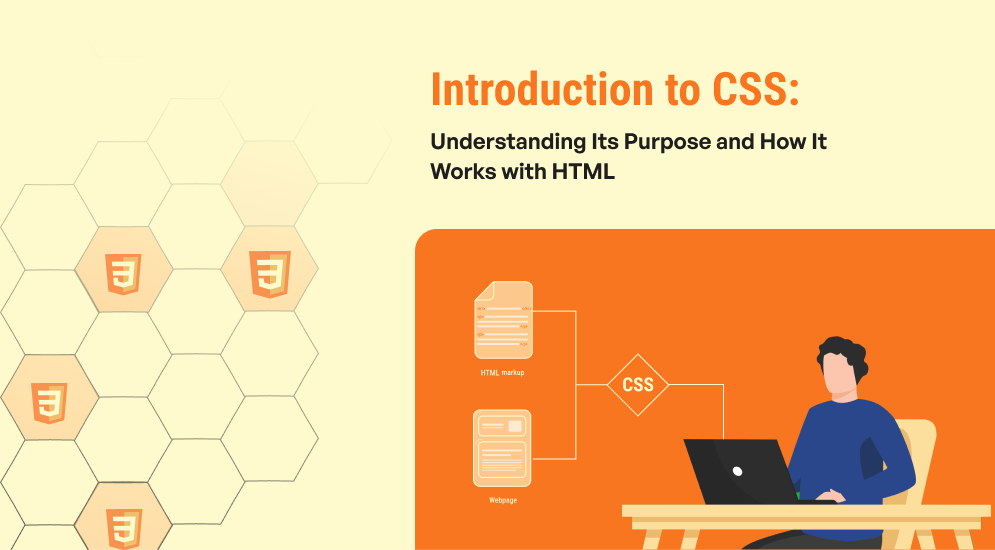
CSS (Cascading Style Sheets) is a language used to control the appearance and layout of webpages. While HTML provides the structure and content of a website, CSS controls how that content looks. How CSS Works in a Website How CSS Works in a Website
For example, HTML can create a heading, paragraph, image, or button, while CSS can control its color, size, spacing, position, background, and overall design. How CSS Works in a Website How CSS Works in a Website
Learn how CSS works in a website and discover how Cascading Style Sheets control colors, fonts, spacing, layouts, backgrounds, borders, animations, and responsive design. This complete beginner-friendly guide explains CSS selectors, properties, the box model, Flexbox, Grid, media queries, positioning, and more. Whether you are new to web development or want to improve your HTML and CSS skills, this guide will help you understand how CSS transforms basic HTML into attractive, responsive, and user-friendly websites.
1. HTML and CSS Work Together
A simple website usually uses HTML and CSS together. How CSS Works in a Website How CSS Works in a Website How CSS Works in a Website
HTML provides the structure: How CSS Works in a Website How CSS Works in a Website
<h1>Welcome to My Website</h1> How CSS Works in a Website
<p>This is my first webpage.</p>
CSS can style that structure: How CSS Works in a Website
h1 {
color: blue;
font-size: 40px;
}
p {
font-size: 18px;
}
The browser combines the HTML and CSS and displays the styled webpage.
2. CSS Syntax
A CSS rule normally contains a selector, property, and value.
h1 {
color: blue;
font-size: 40px;
}
Here:
- h1 is the selector.
- color is a property.
- blue is the property’s value.
- font-size is another property.
- 40px is its value.
The browser uses these instructions to determine how the heading should appear. How CSS Works in a Website
CSS, or Cascading Style Sheets, is one of the most important technologies used in website development. It controls how HTML content looks and how different elements are arranged on a webpage. While HTML provides the basic structure of a website, CSS adds colors, fonts, spacing, borders, backgrounds, layouts, and other visual effects.
Understanding How CSS Works in a Website is important for anyone learning web development. CSS uses selectors to identify HTML elements and properties to define their appearance. For example, developers can change the color of text, adjust font sizes, add background images, control margins and padding, and create attractive layouts.
CSS also provides powerful layout systems such as Flexbox and Grid. These tools make it easier to organize content and create responsive designs that work properly on computers, tablets, and mobile phones. Media queries can further adjust styles according to different screen sizes.
Another important feature of CSS is its ability to create transitions and animations. These features can make websites more interactive and visually appealing without requiring complex code.
CSS can be added to a webpage in three main ways: inline CSS, internal CSS, and external CSS. External CSS is commonly preferred for larger websites because one stylesheet can control the design of multiple pages.
Overall, learning How CSS Works in a Website gives beginners a strong foundation in web design and helps them create modern, responsive, and professional-looking webpages.
3. Three Ways to Add CSS
Inline CSS
CSS can be written directly inside an HTML element.
<p style=”color: blue;”>Hello World</p>
This is useful for small examples but is generally not the best choice for styling an entire website.
Internal CSS
CSS can be placed inside a <style> element in the HTML document.
<style>
p {
color: blue;
}
</style>
This can be useful when styling a single webpage.
External CSS
A separate CSS file can be connected to an HTML page.
HTML:
<link rel=”stylesheet” href=”style.css”>
CSS:
p {
color: blue;
}
External CSS is commonly used for larger websites because one stylesheet can control the design of multiple pages.
4. CSS Selectors
Selectors tell CSS which HTML elements should be styled.
Element Selector
p {
color: black;
}
This applies the style to paragraph elements.
Class Selector
HTML:
<p class=”important”>Important information</p>
CSS:
.important {
color: red;
}
A class can be used on multiple elements.
ID Selector
HTML:
<h1 id=”title”>My Website</h1>
CSS:
#title {
color: green;
}
An ID identifies a particular element.
5. Colors
CSS can change the colors of text and backgrounds.
body {
background-color: white;
}
h1 {
color: black;
}
Colors can be specified using names, hexadecimal values, RGB, and other supported formats.
6. Fonts and Text
CSS allows you to control text appearance.
p {
font-family: Arial, sans-serif;
font-size: 18px;
font-weight: bold;
text-align: center;
}
You can control the font family, size, weight, alignment, spacing, and other text properties.
7. The CSS Box Model
One of the most important CSS concepts is the box model.
Every HTML element can be understood as a box consisting of:
- Content
- Padding
- Border
- Margin
For example:
div {
padding: 20px;
border: 1px solid black;
margin: 15px;
}
Padding creates space inside an element around its content.
Border creates a visible boundary around the element.
Margin creates space outside the element.
8. Website Layout
CSS controls where elements appear on a webpage.
Modern CSS commonly uses Flexbox and CSS Grid for layouts.
Flexbox
Flexbox is useful for arranging elements in rows or columns.
.container {
display: flex;
gap: 20px;
}
CSS Grid
Grid is useful for creating structured layouts with rows and columns.
.container {
display: grid;
grid-template-columns: repeat(3, 1fr);
gap: 20px;
}
9. Responsive Design
Websites need to work on phones, tablets, laptops, and desktop computers.
CSS media queries allow developers to change styles depending on screen size.
@media (max-width: 600px) {
h1 {
font-size: 28px;
}
}
This can make a website more comfortable to use on smaller screens.
10. CSS Animations and Transitions
CSS can create simple visual effects without JavaScript.
For example:
button {
transition: transform 0.2s;
}
button:hover {
transform: scale(1.05);
}
When the user moves the pointer over the button, the browser smoothly applies the defined effect.
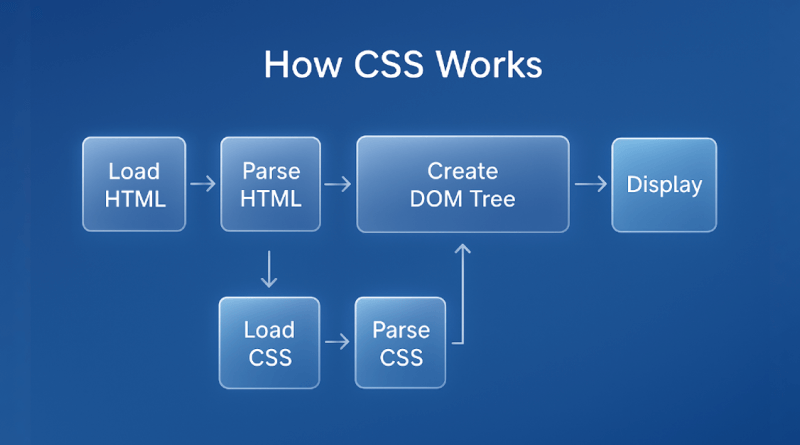
11. How the Browser Applies CSS
When someone opens a webpage, the browser receives the HTML and CSS files.
The browser:
- Reads the HTML.
- Identifies the webpage elements.
- Loads the CSS rules.
- Determines which rules apply to each element.
- Calculates the layout.
- Displays the styled webpage.
If multiple CSS rules affect the same element, the browser uses CSS’s cascade, along with specificity, inheritance, and source order, to determine which styles apply.
12. CSS and JavaScript
CSS and JavaScript have different jobs.
HTML: Creates the structure.
CSS: Controls appearance and layout.
JavaScript: Adds programming logic and interactive behavior.
For example, HTML can create a menu, CSS can make the menu look attractive, and JavaScript can make the menu open and close when a user clicks a button.
13. Why CSS Is Important
CSS makes websites:
- More attractive
- Easier to navigate
- Responsive
- Organized
- Consistent
- More accessible when used thoughtfully
Without CSS, most webpages would have a very basic appearance.
14. How to Learn CSS
A beginner can learn CSS in stages:
Step 1: Learn selectors and syntax.
Step 2: Learn colors, fonts, backgrounds, and borders.
Step 3: Learn the box model.
Step 4: Learn Flexbox.
Step 5: Learn CSS Grid.
Step 6: Learn responsive design.
Step 7: Practice by building small webpages.
Good practice projects include a personal profile page, landing page, blog layout, product page, or simple portfolio.
14. How CSS Works in a Website?
CSS works by applying styling rules to HTML elements, controlling their appearance, spacing, colors, fonts, and layout. How CSS Works in a Website
15. What Is CSS Used For?
CSS is used to style webpages and control their visual design, including colors, fonts, spacing, borders, and layouts. How CSS Works in a Website
16. How Does CSS Style HTML?
CSS uses selectors to target HTML elements and properties to define how those elements should look.
17. What Are CSS Selectors?
CSS selectors identify the HTML elements that you want to style, such as tags, classes, and IDs.
18. What Is an External CSS File?
An external CSS file is a separate .css file containing styling rules that can be connected to one or more HTML pages.
19. What Is Inline CSS?
Inline CSS is written directly inside an HTML element using the style attribute.
20. What Is Internal CSS?
Internal CSS is written inside a <style> element within the HTML document’s <head> section.
21. How Does CSS Control Website Layout?
CSS controls layouts using properties and systems such as Flexbox, Grid, positioning, margins, and padding.
22. What Is Flexbox in CSS?
Flexbox is a CSS layout method that helps arrange and align elements efficiently in rows or columns.
23. What Is CSS Grid?
CSS Grid is a layout system that organizes webpage elements into rows and columns.
24. What Is the CSS Box Model?
The CSS box model consists of content, padding, border, and margin, which together determine how an element occupies space.
25. Can CSS Make a Website Responsive?
Yes. CSS can make websites responsive using flexible layouts, relative units, and media queries.
26. Why Is CSS Important in Web Development?
CSS is important because it separates webpage content from visual presentation and helps create attractive, organized, and responsive websites. How CSS Works in a Website
27. Is CSS Easy to Learn?
CSS is beginner-friendly when learned step by step. Starting with selectors, properties, colors, spacing, and layouts provides a strong foundation.
28. What Is the Role of CSS in a Website?
CSS controls the visual appearance and layout of webpage elements.
29. How Does CSS Work With HTML?
HTML provides the structure of a webpage, while CSS controls how that structure looks and is arranged.
30. What Is a CSS Rule?
A CSS rule contains a selector and declarations that tell the browser how specific HTML elements should be styled.
31. What Is a CSS Declaration?
A declaration consists of a CSS property and its value, such as color: blue;.
32. What Is a CSS Property?
A property defines the specific aspect of an element that CSS will change, such as its color, width, or font size.
33. What Is a CSS Value?
A value specifies the setting applied to a CSS property, such as 20px for font-size.
34. What Is a Class Selector?
A class selector targets HTML elements that have a specific class name.
35. What Is an ID Selector?
An ID selector targets an HTML element with a specific id attribute.
36. What Is the Universal Selector in CSS?
The universal selector * targets all elements on a webpage.
37. What Is CSS Specificity?
Specificity determines which CSS rule takes priority when multiple rules target the same element.
38. What Does the Cascade Mean in CSS?
The cascade is the process browsers use to determine which CSS declarations should be applied when multiple rules conflict.
39. What Is CSS Inheritance?
Inheritance allows certain CSS properties applied to a parent element to be passed down to its child elements.
40. How Does CSS Change Text?
CSS can control text color, font family, font size, weight, alignment, spacing, and decoration.
41. How Does CSS Change Backgrounds?
CSS provides properties for background colors, images, positioning, sizing, and repetition.
42. How Does CSS Add Space Around Elements?
CSS uses margin to create space outside an element and padding to create space inside an element.
43. What Is Margin in CSS?
Margin creates space around the outside of an HTML element.
44. What Is Padding in CSS?
Padding creates space between an element’s content and its border.
45. What Is a CSS Border?
A border creates a visible boundary around an element and can be customized by width, style, and color.
46. How Does CSS Set Element Width and Height?
Properties such as width and height can define the dimensions of an element. How CSS Works in a Website
47. What Is the Display Property in CSS?
The display property controls how an element participates in the page layout. How CSS Works in a Website
48. What Is display: block?
A block element generally starts on a new line and can occupy the available horizontal space.
49. What Is display: inline?
An inline element generally takes only the space required by its content and remains within the surrounding text flow.
50. What Is display: inline-block?
inline-block allows an element to remain in an inline flow while also supporting dimensions such as width and height.
51. What Is Positioning in CSS?
CSS positioning controls how elements are placed within a webpage using properties such as position, top, right, bottom, and left.
52. What Is position: relative?
Relative positioning allows an element to be moved from its normal position while maintaining its original space in the layout.
53. What Is position: absolute?
Absolute positioning removes an element from normal document flow and positions it relative to an appropriate containing block.
54. What Is position: fixed?
Fixed positioning keeps an element positioned relative to the viewport, so it can remain visible while the page scrolls.
55. What Is position: sticky?
Sticky positioning allows an element to behave normally until a specified scrolling position is reached, after which it can remain visible within its container. How CSS Works in a Website
56. What Is z-index in CSS?
z-index helps control the stacking order of positioned elements. How CSS Works in a Website
57. How Does CSS Center an Element?
Depending on the situation, CSS can center elements using Flexbox, Grid, margins, or other layout techniques.
58. What Is a Media Query?
A media query allows CSS rules to be applied based on conditions such as screen width or device characteristics.
59. Why Are Media Queries Important?
Media queries help developers create responsive websites that work across different screen sizes.
60. What Are CSS Units?
CSS units define measurements. Common units include px, %, em, rem, vw, and vh. How CSS Works in a Website
61. What Is the Difference Between px and %?
px represents a pixel-based measurement, while % generally represents a value relative to another dimension or property.
62. What Is rem in CSS?
rem is a relative unit based on the font size of the root HTML element.
63. What Is em in CSS?
em is a relative unit whose size is generally calculated based on the font size of the relevant element or its parent. How CSS Works in a Website
64. What Is vh in CSS?
vh stands for viewport height and represents a percentage of the browser viewport’s height.
65. What Is vw in CSS?
vw stands for viewport width and represents a percentage of the browser viewport’s width.
66. Can CSS Add Animations?
Yes. CSS supports animations and transitions that can create visual effects when elements change state.
67. What Are CSS Transitions?
Transitions allow CSS property changes to happen gradually over a specified period.
68. What Are CSS Animations?
CSS animations allow developers to define multiple stages of an animation using keyframes.
69. What Are CSS Pseudo-Classes?
Pseudo-classes target elements based on a particular state or condition, such as :hover, :focus, or :first-child.
70. What Are CSS Pseudo-Elements?
Pseudo-elements allow developers to style a specific part of an element or generate certain content, such as ::before and ::after. How CSS Works in a Website
71. How Does CSS Work on Mobile Websites?
CSS uses responsive layouts, flexible dimensions, and media queries to adapt webpage designs to mobile screens.
72. Can CSS Improve Website Design?
Yes. CSS provides extensive control over typography, colors, spacing, layouts, responsive behavior, and visual effects.
73. Can CSS Be Used to Create Dark Mode?
Yes. CSS can create dark-mode designs using different colors and themes, often combined with user preferences or JavaScript.
74. What Is a CSS Framework?
A CSS framework is a collection of predefined styles and components that can help developers build websites more quickly.
75. What Is the Best Way to Learn How CSS Works in a Website?
Start with selectors and basic properties, then learn the box model, Flexbox, Grid, responsive design, positioning, and animations through practical projects.
Conclusion
CSS is responsible for much of the visual design of modern websites. It works with HTML to control colors, fonts, spacing, layouts, animations, and responsive behavior.
The basic relationship is simple:
HTML = Structure
CSS = Design
JavaScript = Behavior
Once you understand CSS selectors, the box model, Flexbox, Grid, and responsive design, you can create webpages that look professional and work across different screen sizes.