How New Freelancers Can Use AI and Technology to Build a Successful Freelance Business in 2026

Starting a freelance business in 2026 is both easier and more competitive than it was a few years ago.
A new freelancer can now use artificial intelligence, automation, cloud software, online collaboration platforms, digital marketing tools, and other technologies to perform work faster and serve clients from almost anywhere.
But there is an important difference between using AI and building a successful business with AI.
Simply asking an AI tool to produce work is unlikely to create a long-term advantage. The more valuable approach is to combine AI with a real skill, human judgment, communication, creativity, and an understanding of what clients actually need.
Recent 2026 research from Upwork shows this shift clearly. AI-related skills are growing rapidly, while higher-value freelance work increasingly involves professionals who combine AI with expertise and judgment. Upwork’s research describes this emerging type of professional as an “AI orchestrator”—someone who connects AI tools with real business workflows and outcomes.
For someone starting from scratch, this creates an important opportunity.
What Is a Freelance Business?
A freelance business is a professional service business in which you provide your skills to clients on a project, hourly, retainer, or other agreed basis.
Freelancers can work in areas such as:
- Web design
- Graphic design
- Video editing
- Content writing
- SEO
- Digital marketing
- Programming
- Data analysis
- Virtual assistance
- Customer support
- Research
- Translation
- AI implementation
- Automation
The goal should not simply be to “find online work.”
The goal should be to build a repeatable business around a skill that solves a real client problem.
Why AI Is Changing Freelancing in 2026
AI has changed how many freelance tasks are performed.
Research from Upwork found that demand for skills explicitly connected to AI increased 109% year over year in its 2026 marketplace data. At the same time, established skills such as development, virtual assistance, data analytics, and graphic design continued to have strong demand.
This means beginners shouldn’t assume they need to become AI programmers.
Instead, a better strategy is:
Choose a useful skill → learn how AI can improve that skill → create a service → demonstrate results → find clients.
For example:
A writer can learn AI-assisted research and editing.
A designer can learn AI-assisted ideation and image workflows.
A marketer can use AI for research, campaign planning, analysis, and reporting.
A web designer can use AI to speed up development while still handling design, testing, usability, and client requirements.
The valuable combination is human expertise + AI capability.
Step 1: Choose One Main Freelance Skill
One of the biggest mistakes beginners make is trying to offer everything.
A new freelancer might create a profile saying:
“I do SEO, writing, web design, graphic design, video editing, social media, data entry, AI, and marketing.”
That doesn’t communicate a clear business value.
Instead, choose one primary service.
For example:
SEO freelancer
or
WordPress website designer
or
Short-form video editor
or
AI-assisted content specialist
or
Small-business virtual assistant
You can add related services later.
Use the “one skill + AI” strategy
Instead of trying to become an expert in dozens of AI tools, combine one marketable skill with AI.
Examples:
- SEO + AI
- Writing + AI
- Design + AI
- Video editing + AI
- Web development + AI
- Marketing + AI
- Data analysis + AI
- Virtual assistance + AI automation
This approach gives you a clearer identity and makes it easier for potential clients to understand what you offer.
Step 2: Learn AI as a Productivity System
Don’t learn AI only by memorizing prompts.
Learn how AI fits into an actual workflow.
For example, a content freelancer might use AI for:
- Research planning
- Topic organization
- Content outlines
- Draft assistance
- Editing
- Fact-checking
- Creating variations
- Creating content briefs
- Summarizing information
- Building reports
The freelancer still needs to review the work.
AI can make a process faster, but the freelancer remains responsible for quality.
This distinction is becoming increasingly important because low-complexity AI-generated work can become easier to produce and therefore more competitive, while higher-value work requires expertise and judgment.
Step 3: Build a Professional Portfolio
A portfolio is more powerful than simply telling clients that you have skills.
If you have no clients yet, create sample projects.
For example, if you want to become an SEO freelancer, create:
- A sample keyword research report
- A sample website audit
- A sample content brief
- A sample on-page SEO improvement
- A sample competitor analysis
If you want to become a designer, create several fictional business projects.
If you want to become a video editor, create sample edits using material you are permitted to use.
Your portfolio should demonstrate what you can actually do.
Step 4: Create a Specific Service Offer
Don’t sell “AI services.”
Sell a solution.
Weak offer:
“I use AI to create content.”
Better:
“I help small businesses create search-focused blog content with AI-assisted research and human editing.”
Weak:
“I do marketing.”
Better:
“I help small businesses organize their content strategy and create a monthly SEO content plan.”
The client is interested in the result, not merely the technology you use.
Step 5: Learn to Work Faster Without Sacrificing Quality
Technology should reduce repetitive work.
Create reusable systems for:
- Client onboarding
- Project briefs
- Research
- Task management
- Drafting
- Editing
- Quality control
- Reporting
- Invoicing
- Follow-up
For example, you could create a standard onboarding questionnaire that collects:
- Business name
- Website
- Target audience
- Main objectives
- Existing problems
- Competitors
- Deadline
- Expected deliverables
This saves time every time you get a new project.
Step 6: Use AI for Research—but Verify Important Information
AI can help you organize ideas and research topics, but freelancers should not blindly trust generated information.
Before delivering professional work:
- Verify important facts
- Check numbers
- Review sources
- Test technical instructions
- Check spelling and grammar
- Remove unsupported claims
- Make sure the final result matches the client’s requirements
Your reputation depends on the quality of the final product.
Step 7: Learn Communication
Technology cannot replace professional communication.
A successful freelancer should learn how to:
- Ask useful questions
- Understand requirements
- Explain problems clearly
- Give realistic deadlines
- Provide progress updates
- Respond professionally
- Accept constructive feedback
- Document completed work
These skills become even more important as AI makes basic production easier.
Upwork’s 2026 research specifically points toward the growing value of professionals who combine technical fluency with judgment, communication, and business understanding.
Step 8: Find Your First Clients
Your first objective should not be to build a huge business immediately.
Focus on getting your first few successful projects.
Potential routes include:
- Professional networking
- A personal website
- Relevant online communities
- Direct outreach to businesses
- Referrals
- Freelance marketplaces
- Existing professional contacts
When approaching a potential client, avoid sending a generic message to everyone.
Research the business first.
For example, instead of saying:
“I am an expert freelancer. Do you need my services?”
You could identify a specific problem and explain how your service could help solve it.
The goal is to demonstrate that you understand the client’s business.
Step 9: Build a Simple Personal Brand
You don’t need an expensive website to start.
A simple professional presence can include:
- Your name
- Your specialization
- Short description of your service
- Portfolio
- Contact method
- Testimonials when you have them
- Examples of your work
Publish useful content related to your specialty.
For example, an SEO freelancer could publish:
- SEO tips
- Website audits
- Keyword research examples
- Search optimization tutorials
- Case studies
Over time, this can demonstrate expertise and attract potential clients.
Step 10: Focus on Results, Not Hours

One of the biggest changes AI brings to freelancing is that clients may increasingly care about outcomes rather than how many hours a freelancer spends.
Suppose a task traditionally takes four hours but automation allows you to complete it in two.
That doesn’t necessarily mean your work is worth half as much.
If you deliver the same or better result efficiently, your productivity has improved.
This is why freelancers should gradually move from selling only their time toward selling expertise, solutions, and outcomes.
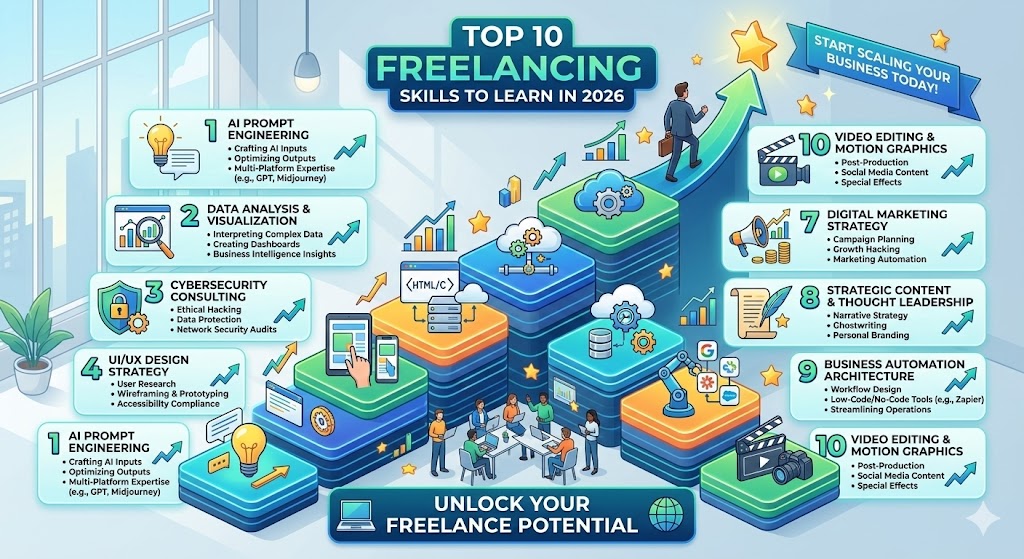
Freelance Skills Worth Considering in 2026
Current marketplace data shows continued demand across both AI-related and established professional skills.
Upwork’s 2026 data highlights areas including AI integration, AI video generation and editing, AI data work, AI image generation, AI chatbot development, full-stack development, virtual assistance, data analytics, graphic design, and other professional skills.
A beginner could therefore consider combinations such as:
| Core Skill | AI Advantage |
| SEO | Faster research and content workflows |
| Writing | Research, outlining and editing assistance |
| Graphic Design | Faster ideation and production |
| Video Editing | Faster editing and content workflows |
| Web Design | Faster development and prototyping |
| Data Analysis | Faster organization and analysis |
| Virtual Assistance | Automation and workflow management |
| Marketing | Research, planning and reporting |
| Programming | Coding assistance and testing |
| Customer Support | Knowledge organization and response drafting |
The key is not to chase every trend.
Choose a skill that interests you and develop enough expertise to solve real problems.
A Simple 90-Day Plan for a New Freelancer
Days 1–30: Learn
Choose one main skill.
Spend your time learning:
- Fundamentals
- Professional tools
- AI applications
- Client requirements
- Quality standards
Create several practice projects.
Days 31–60: Build
Create:
- Portfolio
- Professional profile
- Service packages
- Sample proposals
- Personal website or professional page
Start contacting potential clients.
Track every response and improve your approach.
Days 61–90: Improve
Once you begin getting opportunities:
- Improve your portfolio
- Collect legitimate testimonials
- Identify your strongest service
- Improve your workflow
- Create repeatable processes
- Increase your expertise
- Develop a specialization
Don’t measure success only by how many messages you send.
Measure:
conversations → proposals → projects → repeat clients → referrals.
Common Mistakes New Freelancers Should Avoid
1. Trying to learn everything
Specialization makes it easier to communicate your value.
2. Depending completely on AI
AI should assist your expertise rather than replace your thinking.
3. Copying other freelancers
Build your own portfolio and professional identity.
4. Offering extremely cheap work
Low prices don’t automatically create a successful business.
Instead, focus on becoming better at solving a specific problem.
5. Ignoring communication
A technically strong freelancer can still lose clients through poor communication.
6. Having no portfolio
Create samples if you don’t have paid client work yet.
7. Promising unrealistic results
Build trust by being honest about what you can deliver.
8. Chasing every new AI tool
Tools change quickly.
Fundamental skills, business knowledge, communication, and problem-solving remain valuable.
The Future Freelancer Is an AI-Enabled Professional
The most interesting lesson from the 2026 freelance market is that AI doesn’t simply create a choice between “human” and “machine.”
The opportunity is in combining both.
A freelancer who knows SEO can use AI to improve research.
A developer can use AI to accelerate coding while handling architecture, testing, and business requirements.
A designer can use AI for ideation while applying human creativity and design judgment.
A marketer can use AI for research and analysis while making strategic decisions.
This is the direction suggested by current marketplace data: higher-value work increasingly comes from combining AI capabilities with specialized expertise rather than simply producing more AI-generated outputs.
Final Thoughts
Starting a freelance business in 2026 is challenging, but technology has also lowered many barriers to entry.
A beginner doesn’t need to master every AI application or become an expert in dozens of skills.
A better formula is:
One valuable skill + AI capability + strong communication + portfolio + consistent client development = a stronger freelance business.
Start small.
Choose a specific service.
Learn the technology that improves that service.
Create useful examples.
Solve real client problems.
Then gradually build systems, reputation, repeat business, and specialization.
The goal isn’t to become someone who simply knows how to use AI.
The goal is to become a professional who knows how to use AI and technology to produce valuable results for clients